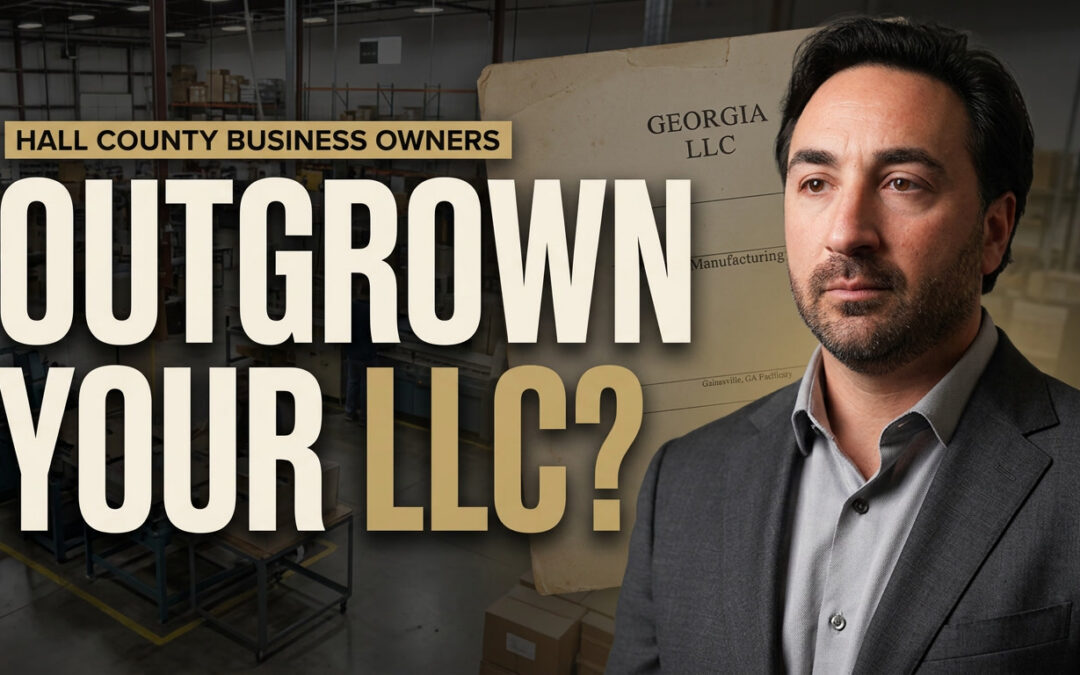
Hall County has an unusually industrial economy for a place its size. More than 330 manufacturing and processing operations run here, including 66 locations of international companies from 19 different countries. Since 2020 the county has announced more than 4,700 new jobs and around two billion dollars in new capital investment. Cottrell has been building car-hauling trailers in Gainesville for decades. The poultry complex anchors an entire supply chain around it.
That mix produces a specific kind of business owner: someone running a real operation with equipment, inventory, a payroll, and often a building, who formed the company as an LLC at a lawyer’s office years ago and has never revisited it.
The LLC was almost certainly the right answer at the time. It is fast, cheap, flexible, and it provides liability protection. The question is whether it is still the right answer now that the business looks nothing like it did then.
The Distinction Almost Everyone Gets Backwards
Before comparing anything, one thing has to be clear, because it causes more confusion in this conversation than anything else.
An LLC is a legal structure created under Georgia law. S-Corp is a tax election made with the IRS. They are not two items on the same menu.
That means a Hall County LLC can keep being an LLC in every legal sense, keep its name, keep its operating agreement, keep its liability protection, and still elect to be taxed as an S-Corporation. Nothing about the legal entity has to change. What changes is how the IRS treats the income.
This matters because a lot of owners believe switching to an S-Corp means dissolving the company they built and starting over. It usually does not.
The LLC on Its Own
Taxed by default, a single-member LLC is treated as a sole proprietorship and a multi-member LLC as a partnership. Profit flows straight to the owners’ personal returns.
The advantage is simplicity. One return, no payroll requirement for the owner, minimal administration, and total flexibility in how a multi-member operating agreement splits things up.
The cost is self-employment tax on the entire profit. At startup profit levels that is a fair trade for the simplicity. As profit grows it becomes the single largest tax the business pays, and it can become one of the largest ongoing taxes the owner pays.
Where it fits: newer Hall County businesses, side operations, holding companies for real estate, and any business where profit has not yet reached a level that justifies payroll administration.
The S-Corp Election
The election splits owner compensation into a reasonable W-2 salary, which carries payroll tax, and distributions of remaining profit, which do not. That split is the savings.
The tradeoffs are real. The business has to run actual payroll, file a separate return, and defend the salary number as reasonable compensation, which is a facts-and-circumstances judgment rather than a formula. There are also ownership restrictions: a limited number of shareholders, all generally required to be US individuals or certain trusts, and only one class of stock. That last one matters for a growing Gainesville manufacturer that might eventually want outside investment with different terms.
Where it fits: the largest share of established Hall County operating businesses. A profitable trades company, a distribution operation, a processing supplier, a professional practice. If the business has meaningful profit above what the owner would earn as an employee, this election deserves a look. The post on the three signs a business has outgrown its LLC covers when that threshold is genuinely crossed, and the S-Corp salary post covers setting the number afterward.
The C-Corp
The C-Corp is a separate taxpayer. It pays corporate tax on its profit, and then shareholders pay again on dividends they receive. That double taxation is why the C-Corp fell out of favor with small business owners and why most advisors reach for it last.
But it is not always wrong, and there are two situations where Hall County owners specifically should ask the question.
The first is a business retaining significant earnings rather than distributing them. A capital-intensive manufacturer plowing profit back into equipment, facilities, and expansion is not pulling much out to be taxed twice, and the corporate rate applied to retained profit can compare favorably to a high personal rate on the same money.
The second is Qualified Small Business Stock. Under Section 1202, stock in a qualifying C-Corp held for the required period can allow a substantial exclusion of gain when it is sold. For a founder building something intended to be sold rather than held for income, that is a significant consideration, and it is only available to C-Corps. It also comes with strict qualification rules and a long holding requirement, which is exactly why it has to be considered early rather than in the year of a sale.
C-Corps also offer the broadest treatment of fringe benefits and no restrictions on who or what can own the stock, which matters for a business taking on outside or international investment. In a county hosting operations from 19 countries, that is not a hypothetical.
Where it fits: capital-intensive businesses retaining earnings, companies planning to raise outside capital, and founders building specifically toward an eventual sale.
What Actually Decides It
The honest version is that the right entity depends on four things that have nothing to do with which structure sounds most sophisticated.
How much profit the business makes, and how much of it the owner takes out. An owner drawing most of the profit and an owner leaving most of it in the business have genuinely different answers.
What the owner intends to do with the business. Hold it and pass it to a child. Sell it in twelve years. Bring in a partner. Take on investment. Each pulls in a different direction, and the structure should match the destination, not just the current tax year.
Who owns it and who might own it. Multiple owners, family members, trusts, or an outside investor all interact with entity rules differently.
What plans the owner wants on top of it. Retirement plan options, salary strategy, and most advanced tax planning all sit on the entity. This is why entity choice is one of the foundational planning decisions. The tax reduction strategies that stack on top of it are laid out here.
The Real Risk in Hall County
The risk here is not choosing wrong at the beginning. Nearly everyone starts with an LLC and that is fine.
The risk is that nobody revisits it. A Gainesville business that has tripled in profit over eight years, added a building, and hired twenty people is a different company operating inside a structure chosen for a different company. There is no automatic trigger, no notice in the mail, no point at which the state or the IRS suggests taking another look. It just keeps running as it was set up, and the cost of that shows up as a slightly larger tax bill every single year.
Matt Losanno does not file returns or form entities. As a financial advisor working with Hall County and Gainesville, GA business owners, his role is to bring the entity question back onto the table alongside your CPA and attorney, look at it against where the business is actually headed rather than where it started, and make sure the structure underneath everything else is still the right one.
See Where Your Tax Strategy Stands
Free. Five minutes. Built around your actual situation, not generic assumptions.
Or if you want to go deeper, you can schedule a Tax Strategy Review directly.
This content is for educational and informational purposes only. It does not constitute tax, legal, or investment advice. Entity selection depends on facts specific to your business, ownership, and goals, and carries legal and tax consequences in both directions. Qualified Small Business Stock treatment under Section 1202 has strict qualification and holding period requirements that are not summarized in full here. Consult your CPA and attorney before forming, converting, or electing a different structure.